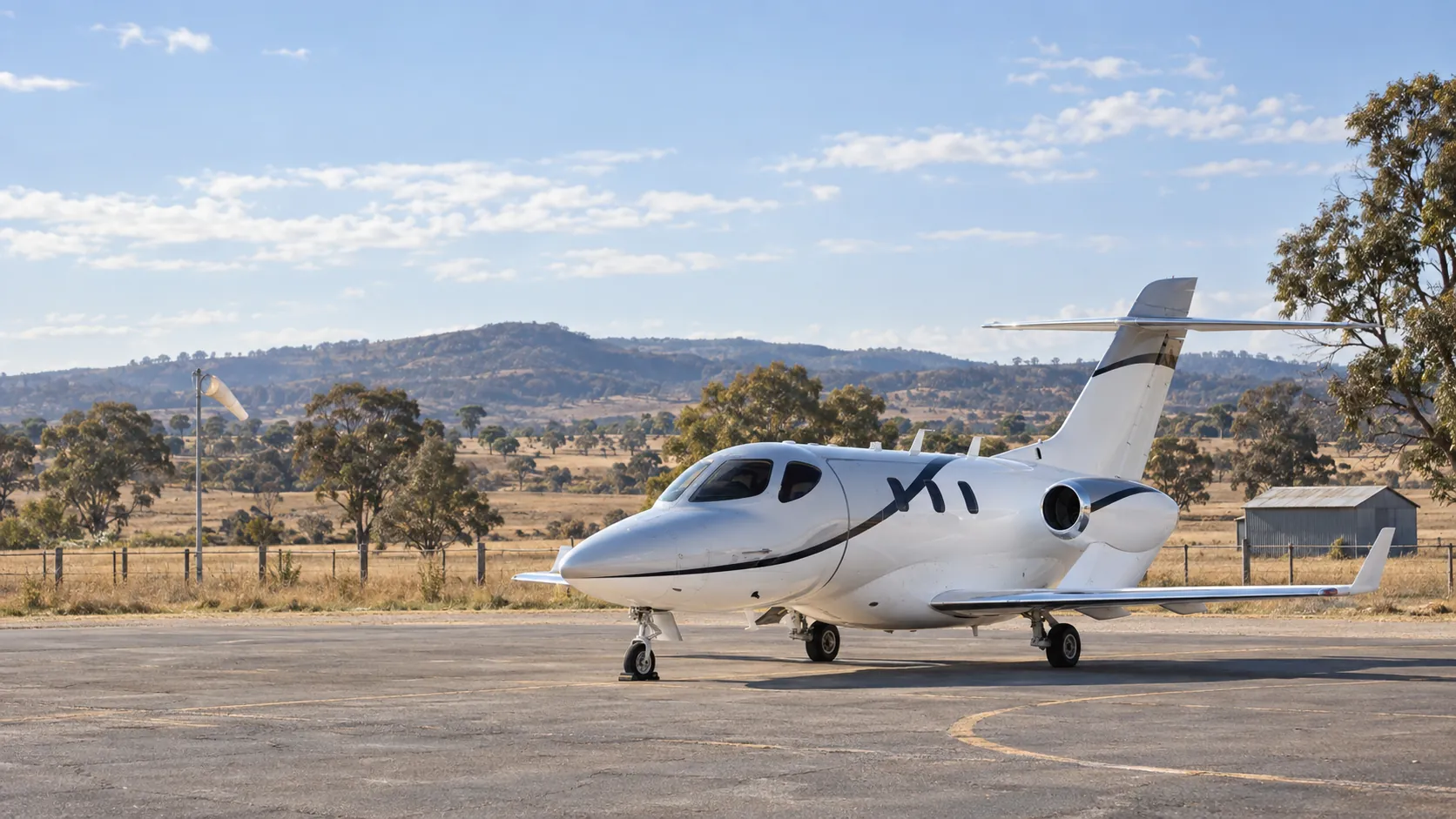
Most charter companies in Australia charge by the hour, and the rate depends mostly on the type of aircraft. Light jets typically cost between $3,000 and $6,000 an hour. Midsize jets cost between $6,000 and $10,000. The larger jets built for long flights generally start at $10,000 an hour and climb from there. Those figures come from FlightCharter, Charter One Aviation and Air Charter Network, all of which publish Australian rates.
The hourly figure is only part of the price. Air Charter Network says most operators bill a minimum of one and a half to two flight hours per trip, so a 40 minute hop is not charged as 40 minutes. Positioning the aircraft, airport charges, catering and crew costs are added on top, which is why a published rate and a real quote rarely match.
Prices shown are published estimates only. Your final price will depend on the aircraft available, travel date, route, passenger numbers, luggage and any additional fees. Request a quote from the charter company for an exact price.
Hourly rates by aircraft category
| Category | Example aircraft | Seats | FlightCharter | Charter One (Mar 2026) | Air Charter Network (Sep 2025) |
|---|---|---|---|---|---|
| Turboprop | King Air 200, Pilatus PC-12 | 6 to 12 | Not published | $2,500 to $4,500 | Not separated from light jets |
| Light jet | Citation CJ3, Phenom 300 | 4 to 8 | $3,000 to $5,000 | $4,000 to $6,000 | $3,822 to $6,880 |
| Midsize | Citation XLS, Hawker 800XP, Learjet 45, Praetor 500 | 6 to 9 | $5,000 to $8,000 | $7,000 to $10,000 | $6,116 to $12,232 |
| Super-midsize | Not separated by most sources | 8 to 10 | $7,500 to $10,000 | Not separated | Not separated |
| Heavy and long range | Challenger 604, Global 6000, G650ER | 10 to 16 | $10,000 to $15,000+ | $10,000 to $15,000+ | $12,232 to $21,406 |
All figures are per flight hour in Australian dollars. The sources do not say whether their hourly ranges include GST, so ask.
The three sources disagree. Air Charter Network's midsize range tops out at $12,232 where FlightCharter's stops at $8,000, and aircraft age is one likely reason. A 20 year old Hawker and a new Praetor both count as midsize, and Asian Sky Group puts the average age of Australia's charter fleet at 19 years, so the same category label can cover very different aircraft.
What the categories actually mean
A turboprop has propellers driven by a turbine engine. It is slower than a jet but costs less to run, and Charter One's Sydney to Canberra example shows the gap: 45 minutes against 35 in a jet. Charter One prices a Pilatus PC-12, a single-engine turboprop seating six to eight, at $2,800 to $3,500 an hour.
Light jets are the workhorses of Australian domestic charter: four to eight seats, and enough range for Sydney to Brisbane or Melbourne to Adelaide without stopping. Asian Sky Group describes Australia's business jet market as "structurally defined by Very Light and Light jets", so this is the category with the most aircraft to choose from.
Midsize jets seat six to nine. Heavy and long-range jets are the usual choice for Perth from the east coast, or for anything international, though Charter One prices Perth to Melbourne on a light jet. On the published ranges they cost roughly two and a half to three times a light jet per hour, and a transcontinental sector takes three and a half hours or more against about an hour to Melbourne.
What popular routes cost
Operators publish route prices on different bases, and the basis changes the number more than the operator does. A one-way price, a same-day return and a return with an overnight are three different products, and each row below says which one it is.
| Route | Distance | Private flight time | Published price | Basis | Source |
|---|---|---|---|---|---|
| Sydney to Melbourne | 706 km | 70 to 75 min | $10,500 to $13,000 | Light jet, return, ex GST | FlightCharter |
| Sydney to Melbourne | 706 km | 70 to 75 min | From $11,500 plus GST | Same-day return, up to 4 passengers | Navair |
| Sydney to Melbourne | 706 km | 70 to 75 min | $12,000 to $18,000 | Light jet; midsize $18,000 to $25,000 | Charter One |
| Sydney to Brisbane | 751 km | 45 to 80 min | $8,000 to $12,000 | All in | Charter One |
| Sydney to Brisbane | 751 km | 45 to 80 min | $12,000 to $14,500 | Light jet, return | FlightCharter |
| Sydney to Gold Coast | 678 km | About 60 min | $11,600 | Light jet or turboprop, same-day return | Navair |
| Sydney to Gold Coast | 678 km | About 60 min | From $3,747 per person | 4 passengers, Citation Mustang, same-day return, incl. GST (Aug 2026) | Navair |
| Melbourne to Adelaide | 642 km | 40 to 50 min | $10,500 | Light jet or turboprop, same-day return | Navair |
| Melbourne to Gold Coast | 1,329 km | Not published | $20,355 to $57,500+ | Charter | Airly |
| Sydney to Canberra | 236 km | 30 min by jet | $14,000 to $18,000 | Light jet, seven passengers, same-day return | Charter One |
| Sydney to Hamilton Island | 1,522 km | Not published | $16,000 to $20,000+ | Midsize, return | FlightCharter |
| Melbourne to Perth | 2,706 km | About 3.5 hr | $50,000 to $60,000+ | Midsize or heavy, return | FlightCharter |
| Melbourne to Perth | 2,706 km | About 3.5 hr | From about $50,000 light, about $60,000 midsize | Trip type not stated | Charter One |
| Sydney to Perth | 3,284 km | Not published | $105,000 | Mid or heavy jet, same-day return | Navair |
Distances are great-circle, so the actual track flown is longer.
No operator publishes a Melbourne to Brisbane charter price, on the third busiest airline route in the country at 3.65 million passengers in 2025 (BITRE). The sector is 1,379 km, so in our reading a quote should sit between the Sydney to Brisbane figures and Airly's Melbourne to Gold Coast range rather than at either end.
Navair's $105,000 same-day return for Sydney to Perth is about nine times its Sydney to Melbourne price. The distance is only about four and a half times greater. The extra cost comes from the aircraft class Navair quotes, a mid or heavy jet, and from paying for roughly four hours of flight time in each direction.
What it works out to per seat
Charter is priced per aircraft, not per person, so the per-seat cost falls every time you add a passenger. Charter One does this calculation on two routes and gets $2,000 to $3,000 a head for six executives Sydney to Melbourne, and $1,400 to $2,000 a head for six Sydney to Brisbane.
| Route | Aircraft price | Passengers | Per seat | Source of the aircraft price |
|---|---|---|---|---|
| Sydney to Melbourne, light jet | $12,000 to $18,000 | 6 | $2,000 to $3,000 | Charter One (its own calculation) |
| Sydney to Brisbane, all in | $8,000 to $12,000 | 6 | $1,400 to $2,000 | Charter One (its own calculation) |
| Sydney to Canberra, same-day return | $14,000 to $18,000 | 7 | $2,000 to $2,570 | Charter One price, our division |
| Melbourne to Adelaide, same-day return | $10,500 | 6 | $1,750 | Navair price, our division |
| Melbourne to Perth, return | $50,000 | 8 | $6,250 | FlightCharter price, our division |
A same-day business class return on these routes would be the obvious comparison, and it is the number that decides whether a charter is defensible to a board. Virgin publishes lead-in business class fares from $385 one way between Sydney and Melbourne and $359 between Sydney and Brisbane, checked 11 September 2026. Those are the cheapest seats, in limited numbers, and neither airline publishes a same-day return business fare, so check the fare for your date before treating the per-seat figure above as competitive or not.
The arithmetic only holds if you fill the seats. A Citation Mustang seats four, so the six-passenger examples above assume a larger light jet at a higher price. Empty seats do not reduce what you pay.
The costs that sit outside the hourly rate
Positioning. If the aircraft is not already where you are, someone pays for it to get there, and the same applies to sending it home afterwards. FlightCharter says it includes any return-to-base cost in the quote. Adagold warns that on a one-way trip you may be charged for flying the aircraft back to base. Air Charter Network puts it more bluntly and says a positioning fee can double the price you were expecting. Ask which of the three applies before you compare two quotes.
Airport charges. Charter One puts airport fees on the Sydney to Melbourne route at $1,500 to $3,000, and under $500 at a private airfield. Air Charter Network notes that Sydney Airport lifted its minimum runway charge from $91.74 to $519.86. Ask how the charges change if you use Bankstown instead of Kingsford Smith, or Essendon instead of Tullamarine.
Catering. Basic catering is usually included (FlightCharter). Charter One charges $80 to $200 a head for premium catering ordered at least 48 hours ahead, and $200 to $500 for celebration packages. Air Charter Network quotes $76 to $229 a head for standard meals and adds 20 to 50 per cent for last-minute orders.
Crew overnights. If your trip keeps the crew away overnight, you pay for them. Air Charter Network puts this at $305 to $917 per crew member per night.
Timing. Charter One says a booking made within 48 hours of departure typically costs 20 to 30 per cent more, and that booking a month ahead usually gets a better rate. Melbourne Cup week, the Australian Grand Prix, Christmas and Easter are flagged as peak by both Charter One and FlightCharter.
Cancellation. Charter One says cancellation policies vary but typically charge 50 per cent inside 48 hours and 100 per cent inside 24 hours. Check this before you pay a deposit, because the terms vary by operator.
GST. Domestic charter is a taxable supply and carries 10 per cent GST. Some operators quote inclusive, some exclusive, and the difference on a $50,000 charter is $5,000. Always ask which you are looking at.
De-icing runs $300 to $800 and standby time on the ground is billable, both per Charter One.
Three ways to pay less
Empty legs. When an aircraft has to fly somewhere with nobody on board, either to collect its next passengers or to return to base, operators sell that sector cheaply rather than fly it empty. Charter One and Air Charter Network both quote discounts of 25 to 75 per cent, and Airly claims up to 90 per cent with prices from $3,300. Listings on FlightCharter on 29 September 2026 included Gold Coast to the Sunshine Coast on a Challenger 604 at $3,000 and Archerfield to Sydney on a PC-24 at $6,200, both excluding GST. The trade-off is that the route and departure time are fixed, and the flight can be cancelled if the original booking changes.
Prepaid hours. A jet card is a block of flight time bought upfront at a fixed hourly rate. Airly sells 5, 10 and 25 hour blocks and charges $4,795 an hour on a Citation Mustang according to its 2025 pricing, with no repositioning charge. It also published an example of a member flying Gold Coast to Sydney for $9,791 against a last-minute quote elsewhere of $18,936 on the same aircraft type. In our reading, cards suit people who fly often enough to use the hours within the term, which is 12 months on Airly's card.
Fly a turboprop. On short sectors the time penalty is small and the saving is not. Charter One's example is Sydney to Canberra: 45 minutes in a turboprop against 35 in a jet, for about 40 per cent less.
What moves a quote up or down
Aircraft class, distance and timing all move a quote. After that it is mostly logistics. Where the aircraft is based decides your positioning cost. A one-way trip is rarely half the price of a return, because the aircraft still has to get home. Regional strips can rule out jets on runway length, which pushes you to a turboprop at a lower hourly rate. And curfews matter: Essendon Fields effectively locks jets out between 11pm and 6am, while the low-noise jets allowed to use Sydney during its curfew are mostly business jets, so a late departure out of Melbourne may mean using Tullamarine instead.
Is it tax deductible?
Domestic air transport is a taxable supply, so a GST-registered business can claim the input tax credit on a charter used for business travel, provided it holds a tax invoice (ATO). Charter One's worked example is a $20,000 charter returning $1,818. International legs to or from Australia are GST-free.
Private travel is treated differently. Private travel provided to an employee or an associate can be a fringe benefit. Where it is a residual fringe benefit, the ATO values it at the GST-inclusive cost less anything the employee contributes, and it can be reduced under the otherwise-deductible rule where the travel would have been deductible to the employee. Substantiation is required. Charter One cites a 47 per cent FBT rate on the private-use portion. This is general information and the treatment depends on your circumstances, so get advice from your accountant before you book something with a mixed purpose.
Common questions
How much is a three hour private jet flight?
On the published hourly ranges, roughly $9,000 to $18,000 on a light jet, $18,000 to $30,000 on a midsize and $30,000 or more on a heavy jet, before positioning, airport charges and GST. Charter One's Sydney to Cairns example, a three hour flight on a midsize jet, is $25,000 to $32,000 in total, which is a better guide than the raw multiplication.
Is a one-way charter cheaper than a return?
Not usually half. The aircraft still has to reposition, and depending on the operator you may be charged for that empty sector. Adagold says a one-way trip may still carry the cost of flying the aircraft back to base. The exception is an empty leg, which is somebody else's positioning flight sold at a discount.
Can several people split the cost?
Yes, because the price is for the aircraft rather than per seat. Charter One's empty leg example is $9,000 split six ways at $1,500 a head. Cost-sharing outside a commercial charter is a separate arrangement with its own rules under CASA, and it is not the same thing as chartering.
How much does it cost to buy a private jet in Australia?
Buying is a different market with its own maintenance, crew and hangarage costs, and purchase prices are outside the scope of this guide.
Why do two operators quote such different prices for the same route?
Aircraft type and age, where the aircraft is based, whether positioning is included, whether the price includes GST, and whether you are being quoted by the operator or by a broker who adds a margin. Airly claims brokers add 10 to 20 per cent margin and 18 to 35 per cent in repositioning surcharges, which is a competitor's characterisation rather than an independently verified figure, but it points at a real variable.
Compare operators on your route, or request quotes and see the all-in numbers side by side.